
Visual Field Tracker

From an initial idea to a publicly accessible platform, Visual Field Tracker represents the convergence of product thinking, software engineering, cloud infrastructure and artificial intelligence.

Independently conceived, designed, developed and deployed, the project demonstrates how multidisciplinary expertise, combined with modern technologies, can transform a complex real-world problem into an operational digital product.

This series explores the technological and strategic decisions behind its development, highlighting the different disciplines involved in delivering a product from zero to one.

From Idea to Product

Understanding the problem before engineering the solution.

An idea, however innovative, has limited value until it becomes something people can actually use.

Visual Field Tracker originated from a practical question: could people explore and record aspects of their visual perception using an ordinary computer, without dedicated hardware?

Answering that question required more than software development. It required understanding the problem domain, challenging conventional assumptions and exploring alternative interaction models.
Visual Field Tracker logo - An eye shape made of rays moving from the center to the borders
Visual Field Tracker logo

The initial prototype evolved through three years of direct experimentation, observation and refinement. Each iteration contributed to a better understanding of both the problem and the potential solution.

This is where product thinking becomes fundamental. Requirements are not necessarily known upfront. They emerge through experimentation, critical observation and the willingness to reconsider previous decisions.

Rather than starting with a predefined technology stack or a detailed specification, I started with a problem and progressively shaped the product around it.

Technology was never the starting point. It was the means to implement a vision.

The ability to navigate uncertainty, identify meaningful opportunities and translate them into actionable engineering decisions is what makes the difference between implementing requirements and creating products.

Visual Field Tracker is the result of that process: an idea progressively transformed into a tangible, publicly accessible experience.

Engineering the Complex

Translating mathematical and technological complexity into an intuitive digital experience.

One of the most interesting engineering challenges behind Visual Field Tracker is the translation of a physical phenomenon into a software-based experience.

Unlike conventional business applications, the platform needs to establish a relationship between the physical environment, the computer screen and human visual perception.

This introduces several engineering challenges:

  • Mathematical modelling of visual angles, screen dimensions and viewing distances.
  • Dynamic rendering and positioning of visual stimuli.
  • Interactive, user-controlled recording sessions.
  • Spatial representation of self-recorded perception patterns.
  • Historical data management and visualization.

These capabilities require the integration of mathematical models, graphical processing, application logic and user interaction.

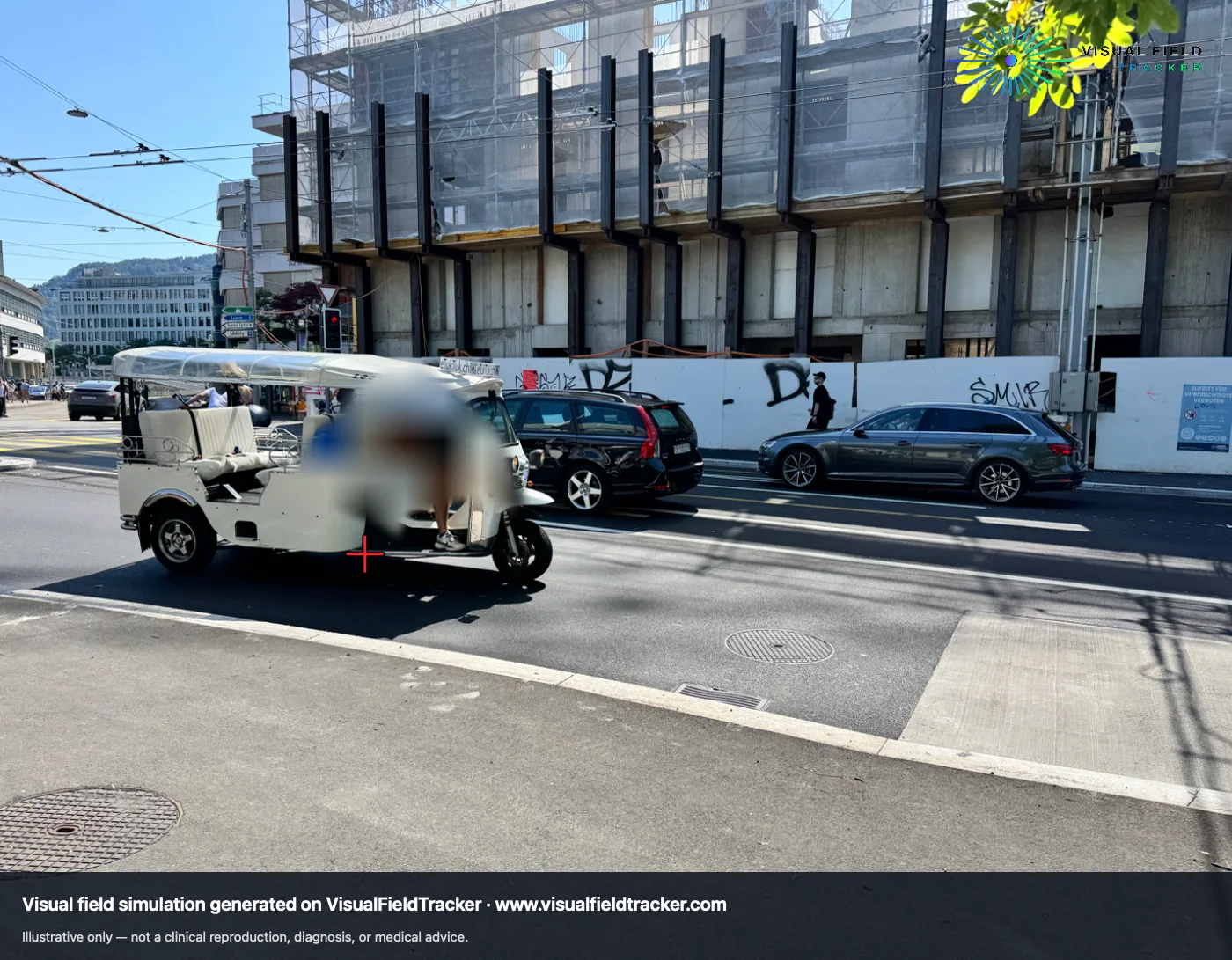
Simulated vision perception of an eye with many floaters and peri-central scotoma
Simulated vision perception of an eye with many floaters and peri-central scotoma. The red cross is the fixation point

However, the most important challenge is not implementing these mechanisms individually. It is making them work together without exposing their complexity to the user.

A sophisticated mathematical model has limited practical value if the interaction required to use it is unnecessarily complicated.

The engineering process therefore involved continuous iteration between mathematical accuracy, technical feasibility and usability, within the limitations of ordinary consumer hardware.

This is a principle I apply to product engineering in general: complexity should be addressed by the architecture and implementation, not transferred to the user.

Good engineering is not about making complexity visible: it is about making complexity manageable.

Architecture with Purpose

Making architectural decisions based on product needs rather than technological trends.

Modern software engineering offers an almost unlimited selection of frameworks, platforms, architectural patterns and infrastructure services.

The challenge, as in many things, is not finding technologies. It is selecting the right ones.

Visual Field Tracker was designed around a deliberately pragmatic technology stack:

  • ASP.NET Core and .NET for application architecture and backend functionality.
  • JavaScript and HTML5 Canvas for interactive graphical processing.
  • SQLite and PostgreSQL for data persistence.
  • Responsive web technologies for cross-platform accessibility.
  • StandardWeb, my own content management system, for the public-facing website.

Each architectural decision was driven by actual product requirements, considering performance, maintainability, security, extensibility and operational costs. Maybe most of all was really about savings.

There was no reason to introduce distributed architectures, complex orchestration platforms or multiple infrastructure dependencies simply because they represent popular industry practices.

Architectural sophistication should not be measured by the number of technologies involved. It should be measured by how effectively the architecture supports the product, how easily it can evolve and how sustainably it can be operated.

This does not mean ignoring future scalability. It means understanding when additional complexity becomes justified.

The architecture behind Visual Field Tracker reflects a principle that has guided much of my professional experience: architecture is a means of delivering value, not an objective in itself.

The best architecture is not necessarily the most advanced one, but the one that best serves its purpose.

From Code to Cloud

Taking ownership of the journey from software development to production infrastructure.

Writing software and delivering an operational product are two fundamentally different achievements.

How many times did you here "it works on my laptop"? And then for some reason the Production environment is broken, the QA is unstable, the DEV drifted in who knows which branch of the branch.

Visual Field Tracker runs on independently managed cloud infrastructure, designed and configured around operational simplicity, technical control and cost efficiency.

The production environment includes:

  • Cloud-based virtual server infrastructure.
  • Linux administration.
  • Reverse proxy and HTTPS certificate management.
  • Network configuration and firewall management.
  • Git-based deployment automation.
  • Database persistence and application configuration.

The deployment workflow connects source code directly to the production environment, reducing manual intervention and simplifying the release process.

Visual field simulation of a peri-central scotoma
Visual field perception simulation involving a peri-central scotoma. The red cross is the fixation point

Managing the entire technology stack provides a comprehensive understanding of how architectural decisions affect infrastructure, performance, security and operational costs.

It also demonstrates that cloud computing does not necessarily require extensive managed-service ecosystems or expensive infrastructure.

The ability to identify the appropriate level of infrastructure complexity is itself an engineering competence.

Visual Field Tracker is not a prototype running on a developer's computer. It is an operational platform accessible worldwide.

For me, production is not where software engineering ends, but when you start feeling that if someone is using your platform on the other side of the world, your responsibility runs forever.

AI as an Engineering Multiplier

Redefining what experienced technology professionals can achieve.

Artificial intelligence is fundamentally changing the economics of software engineering and product development.

Its greatest potential, however, is not simply the ability to generate source code.

Throughout the development of Visual Field Tracker, AI has been leveraged across different dimensions of the product lifecycle:

  • Exploring alternative solutions.
  • Challenging architectural decisions.
  • Accelerating software implementation.
  • Investigating technical problems.
  • Supporting documentation and content creation.
  • Critically reviewing product decisions.

AI makes it possible to explore a broader range of possibilities, reduce repetitive work and significantly shorten the distance between an idea and its implementation.

But acceleration without direction does not necessarily produce better results. At all... Perhaps it actually creates the feeling you can go blind, and potentially that's true, but the far you go the riskier it is.

If something was wrong and you keep that debt for a long time, it multiplies.

So the ability to formulate the right questions, establish constraints, evaluate generated solutions and integrate them into a coherent architecture remains fundamental.

AI does not remove the need for engineering expertise. It amplifies the effectiveness of those who possess it.

Visual Field Tracker demonstrates how an experienced technology professional can leverage AI to operate across multiple disciplines, maintaining ownership of the product vision, architecture and implementation.

This changes not only how software can be developed, but also what individuals and small teams can realistically achieve.

The opportunity is not simply to replace existing development activities with automated ones. It is to reconsider the boundaries of what can be delivered with limited resources.

AI accelerates execution. Experience gives execution direction.

Beyond Software Engineering

Taking responsibility for the entire product, not just its implementation.

Delivering a product requires much more than the ability to design an architecture or write software.

Bringing Visual Field Tracker into production required addressing multiple dimensions beyond conventional engineering responsibilities:

  • Product positioning and communication.
  • User experience and onboarding.
  • Educational content and discoverability.
  • Privacy and data protection.
  • Legal and regulatory considerations.
  • Infrastructure economics and operational sustainability.
  • Engagement with potential research and institutional partners.

These are not disconnected activities. They are different dimensions of the same product.

Visual Field Tracker is currently an experimental perception-mapping platform, not a clinically validated medical device. Understanding and communicating that distinction is itself part of responsible product ownership.

The project represents the convergence of more than three decades of professional experience across software engineering, architecture, product development and technology leadership.

What makes it particularly representative of my approach is not any individual technical achievement, but the ability to connect all the necessary disciplines and independently transform an idea into an operational product.

  • From problem discovery to product definition.
  • rom mathematical modelling to user experience.
  • From architecture to implementation.
  • From infrastructure to production.

The traditional boundaries between product management, software engineering, architecture and operations are becoming increasingly fluid.

Cloud technologies and artificial intelligence are accelerating this transformation.

The real opportunity is not simply to write software faster.

It is to reduce the distance between vision and reality.